Integrating biometric feedback loops from personal devices into targeted campaign algorithms using protected data pipelines for small-scale developers
Dana Flores · Jul 1, 2026
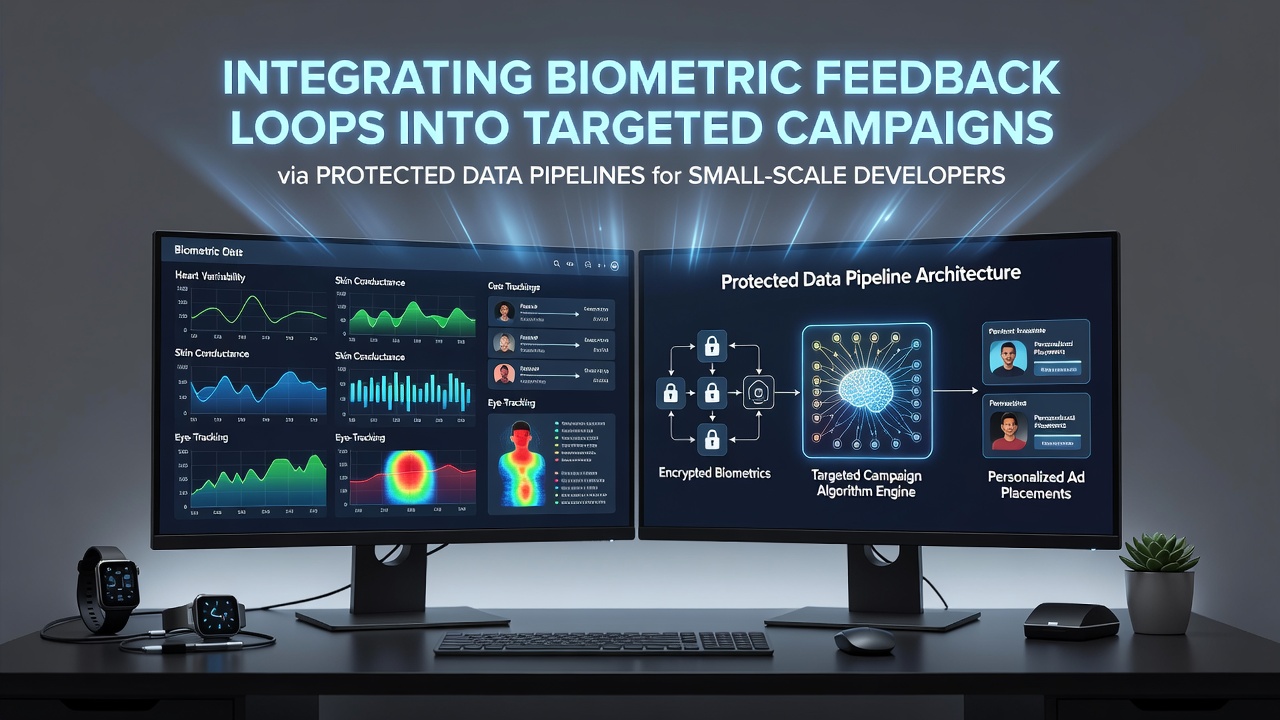
Integrating biometric feedback loops from personal devices into targeted campaign algorithms using protected data pipelines for small-scale developers
Personal devices now collect heart rate variability, skin conductance, and movement patterns at scale, which allows developers to build feedback loops that adjust campaign content in real time. These loops pull signals from fitness trackers and smartwatches, route them through encryption layers, and feed processed metrics into recommendation engines without exposing raw identifiers.
Small-scale developers often start by connecting device APIs such as those provided by Apple HealthKit or Google Fit to cloud functions that strip personally identifiable information before storage. The cleaned data then enters a pipeline protected by end-to-end encryption and access controls that comply with standards from multiple jurisdictions.
Core Components of Biometric Feedback Loops
Feedback loops operate in three stages: signal capture, anonymized aggregation, and algorithmic response. Capture occurs when an app requests permissioned access to biometric streams, aggregation removes timestamps and user IDs through differential privacy techniques, and the response stage modifies campaign parameters such as message timing or creative variants based on detected arousal or fatigue indicators.
Studies published by research institutions show that aggregated heart-rate spikes correlate with higher engagement rates for certain visual stimuli, which gives developers measurable signals to test against conversion data. The same studies note that these correlations weaken when sample sizes drop below several thousand sessions, a threshold many independent teams must address through careful cohort design.
Protected Data Pipelines for Compliance
Protected pipelines rely on tokenization, homomorphic encryption options, and strict key-management practices. Developers route biometric streams through intermediate services that hash identifiers before they reach campaign servers, which reduces the risk of re-identification during model training.
Regulatory frameworks in the European Union, Canada, and Australia each require explicit consent logs and data-minimization steps for biometric categories. Figures from the Office of the Privacy Commissioner of Canada indicate that organizations adopting tokenized pipelines in 2025 reported fewer access requests than those using direct device-to-server connections. Similar patterns appear in Australian Privacy Act enforcement summaries released in early 2026.

Algorithm Integration Patterns
Campaign algorithms incorporate biometric signals as additional feature vectors alongside traditional metrics such as click history and location. Gradient-boosted models or lightweight neural networks can ingest these vectors when developers expose them through secure feature stores rather than raw event logs.
One documented implementation used a federated learning setup where model updates traveled back to a central server without moving individual biometric records. This approach kept raw data on user devices while still allowing the campaign system to refine targeting rules over successive training rounds.
Practical Steps for Small-Scale Teams
Teams begin by auditing device permissions and mapping every biometric data point to its regulatory classification. They then select pipeline tools that support both encryption at rest and in transit, often combining open-source libraries with managed key services from established cloud providers.
Testing occurs in sandbox environments that simulate July 2026 regulatory updates, including expanded audit requirements for cross-border biometric transfers. Developers run synthetic datasets through these environments to verify that campaign adjustments remain within allowed variance thresholds before deployment.
Monitoring dashboards track pipeline latency and consent revocation rates, which helps teams maintain compliance when users withdraw permission mid-campaign. Industry reports from the National Institute of Standards and Technology outline baseline performance metrics for such monitoring systems that many small teams now reference during initial architecture reviews.
Conclusion
Integration of biometric feedback loops into campaign systems requires coordinated choices across device APIs, encryption standards, and model architecture. Small-scale developers who follow documented pipeline patterns and consult region-specific guidance can implement these capabilities while meeting current data-protection obligations. Continued reference to evolving standards through 2026 will determine how widely these methods appear in independent projects.