Exploring Firmware Updates in Embedded Systems to Enhance Compatibility with Emerging IoT Protocols for Agricultural Monitoring
Felix Schwarz · Jul 22, 2026
Exploring Firmware Updates in Embedded Systems to Enhance Compatibility with Emerging IoT Protocols for Agricultural Monitoring
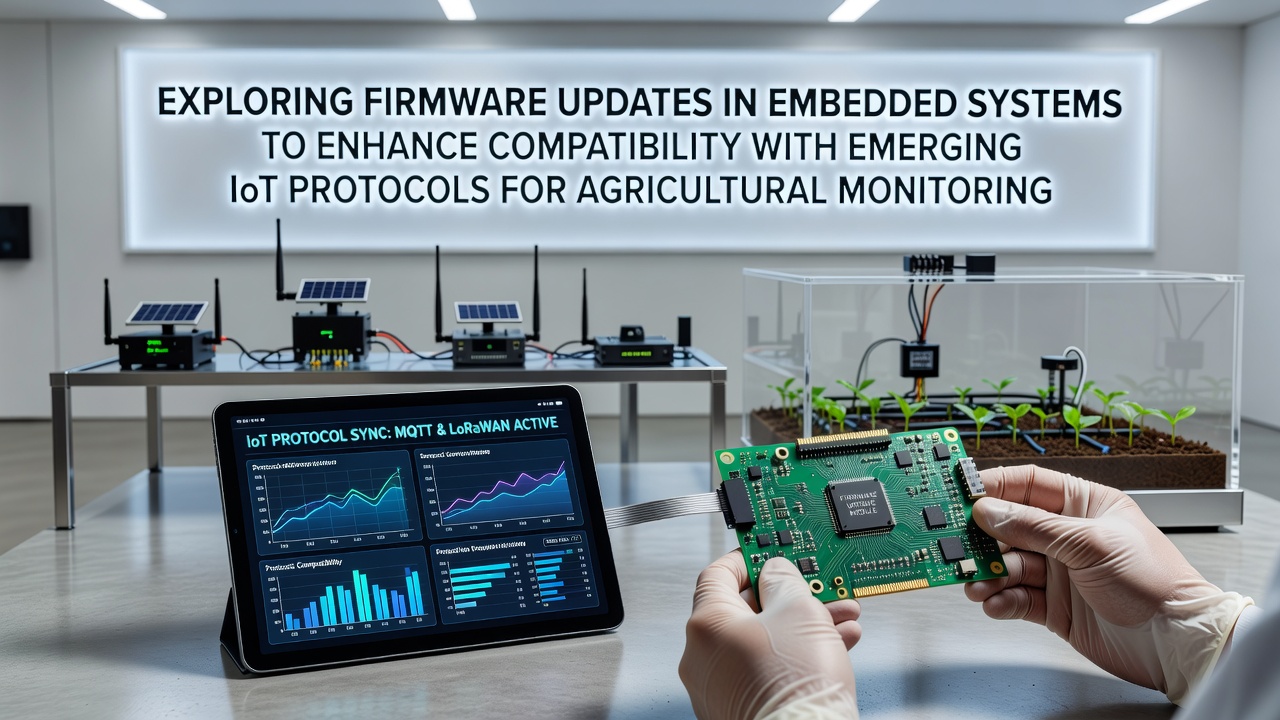
Embedded systems form the backbone of modern agricultural monitoring networks where microcontrollers manage sensors that track soil conditions, weather patterns, and crop health. These systems rely on firmware to handle core operations including data collection, local processing, and transmission over wireless channels. As agricultural operations scale, compatibility with newer IoT protocols becomes essential for seamless integration across distributed sensor arrays and cloud platforms.
Current Landscape of Agricultural IoT Deployments
Precision agriculture deployments now incorporate thousands of nodes per farm in regions such as the Midwest United States and the Murray-Darling Basin in Australia. Each node typically runs on low-power embedded hardware that supports protocols like LoRaWAN, NB-IoT, and the emerging Matter standard for device interoperability. Data from these networks feeds into analytics platforms that optimize irrigation schedules and predict pest outbreaks months in advance.
Research from the Food and Agriculture Organization indicates that global adoption of IoT-enabled monitoring grew by 34 percent between 2023 and 2025, with firmware version control emerging as a primary factor in sustained network performance. Observers note that older firmware versions often lack the packet structures required by updated protocol stacks, leading to dropped connections during peak data transmission periods.
Role of Firmware Updates in Protocol Compatibility
Firmware updates address gaps between legacy embedded code and new protocol specifications by rewriting communication modules, security handshakes, and error-correction routines. In agricultural settings, these updates allow sensors originally designed for Zigbee to operate alongside 5G RedCap devices without hardware replacement. Engineers achieve this through over-the-air delivery mechanisms that verify checksums before installation to prevent bricking during remote field operations.
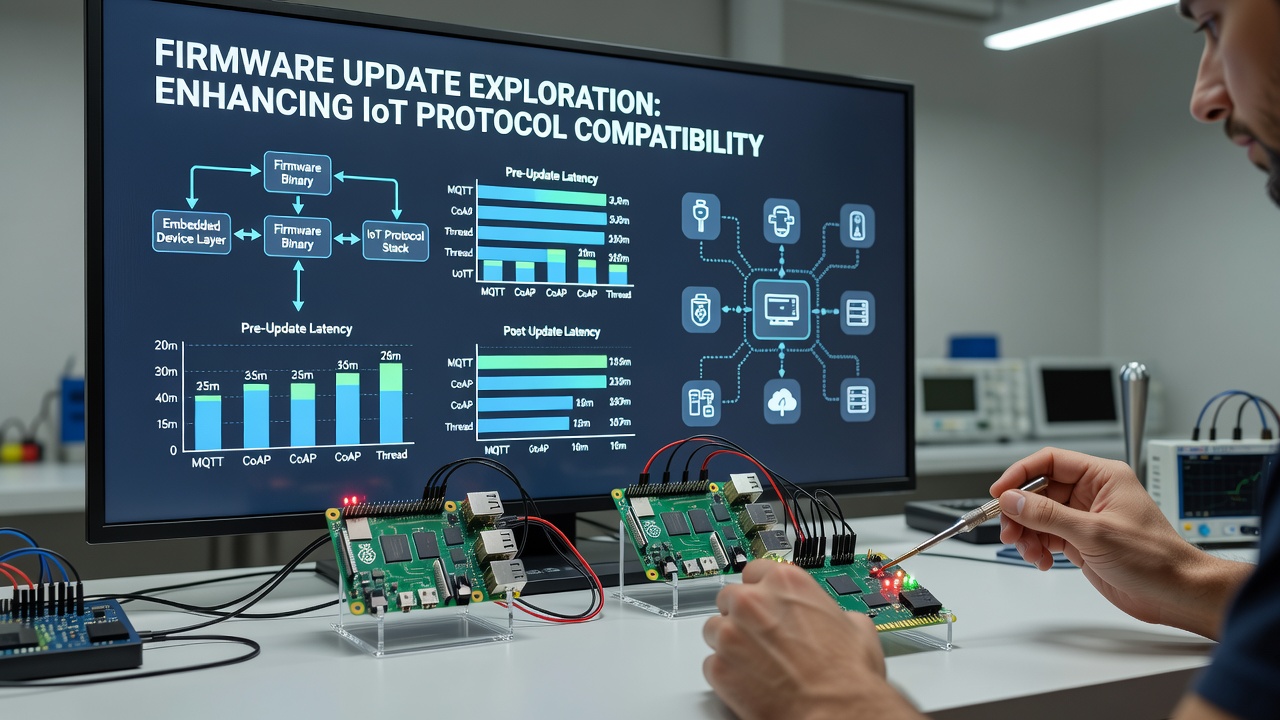
Studies conducted at Wageningen University in the Netherlands demonstrate that targeted firmware patches improved packet delivery rates by 28 percent when transitioning devices to the latest LoRaWAN 1.1 specifications. The patches modified timing parameters and added support for adaptive data rates, features absent in earlier builds. Similar adjustments appear in Canadian prairie monitoring projects where firmware revisions enabled coexistence between legacy Modbus-over-TCP links and newer MQTT-SN implementations.
Technical Challenges in Update Deployment
Bandwidth limitations in rural areas complicate large-scale firmware rollouts because agricultural gateways often share limited cellular or satellite backhaul with operational data streams. Security considerations add further layers since unsigned updates create entry points for unauthorized access to irrigation controls and livestock tracking systems. Developers therefore implement signed delta updates that transmit only changed code segments rather than full images, reducing transmission time by up to 70 percent according to tests reported by the USDA Agricultural Research Service.
Power constraints on battery-operated nodes require updates to occur during scheduled maintenance windows when solar charging peaks. Interruptions from sudden weather events can leave devices in inconsistent states, prompting the use of rollback mechanisms that revert to the previous stable version if boot verification fails. Those who manage large sensor fleets report that staged rollouts across geographic clusters minimize simultaneous disruption risks.
Emerging Protocols and Their Firmware Demands
Protocols such as Wi-SUN and the July 2026 release candidate for enhanced NB-IoT Release 18 introduce requirements for dynamic spectrum access and improved positioning accuracy. These features demand firmware that supports real-time reconfiguration of radio parameters without full system restarts. Agricultural operators in the European Union have begun pilot programs that test these capabilities on vineyards and orchards, where precise location data aids in micro-climate mapping.
Compatibility layers within updated firmware also accommodate hybrid protocol stacks that switch between LoRaWAN for long-range low-bandwidth telemetry and Thread for local mesh coordination among greenhouse actuators. Implementation requires careful memory management on resource-constrained microcontrollers to avoid overflow during concurrent protocol operation.
Implementation Examples Across Regions
One deployment in South Australia integrated firmware updates across 1,200 soil moisture sensors to align with updated LoRaWAN regional parameters released in early 2025. The process involved remote configuration of spreading factors and channel plans, resulting in measurable reductions in retransmission overhead during monsoon season. Another project in the Brazilian cerrado region used similar techniques to bridge embedded systems with emerging 5G IoT slices provided by local carriers.
Academic reports from the University of California, Davis highlight how version-controlled firmware repositories allow researchers to replicate agricultural monitoring setups across multiple continents while maintaining protocol compliance. These repositories include automated testing suites that validate compatibility before distribution to field devices.
Conclusion
Firmware updates serve as the primary mechanism for extending the operational life of embedded agricultural sensors while aligning them with evolving IoT protocol standards. Organizations that maintain systematic update pipelines report higher data integrity and reduced hardware turnover rates across monitoring networks. Continued development of secure, efficient delivery methods will determine how quickly new protocol features reach remote farming operations worldwide.